
The glissando is one of the trombone's most distinctive capabilities — a smooth, continuous slide between two pitches that no other brass instrument can produce in quite the same way. But it comes with a catch: not every pair of notes will work. Whether a glissando is possible depends entirely on the physics of how the trombone produces sound, and figuring it out from first principles is time-consuming for composers and arrangers who don't play the instrument.
This tool takes the guesswork out of it. Select a start note and an end note, hit Check Glissando, and you'll get an immediate answer along with a technical explanation of why.
The result banner will be one of three colors:
The trombone produces pitched sound by vibrating the player's lips inside the mouthpiece. Like any brass instrument, it can only sustain notes that belong to the harmonic series — a fixed sequence of pitches built on a fundamental. On the trombone, each harmonic is called a partial, numbered upward from the lowest: pedal tones (1st partial), then the 2nd through 9th partials in normal playing range.
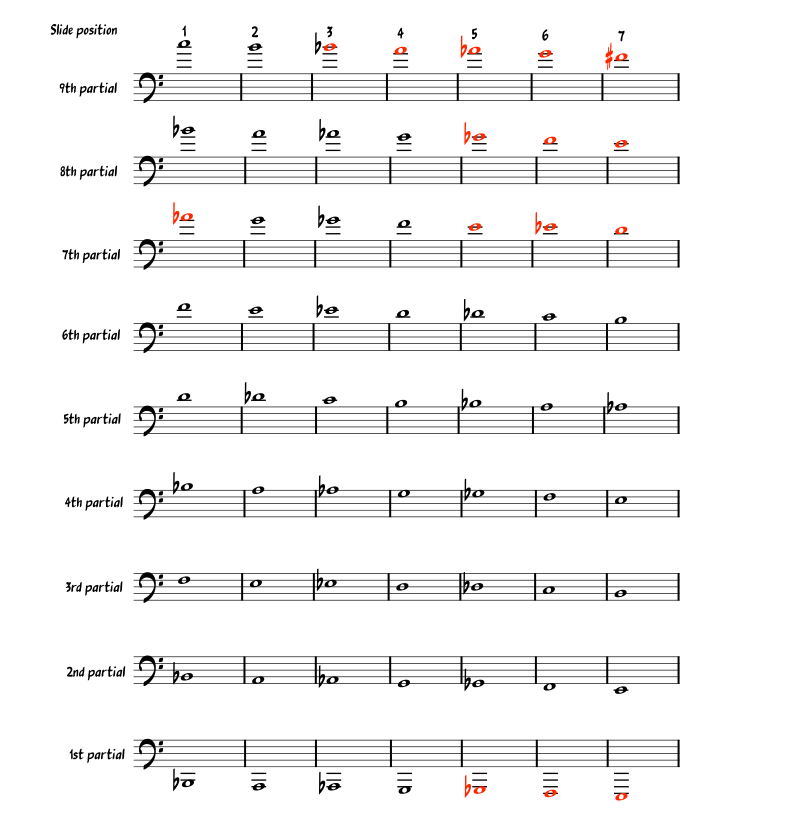
The slide has seven positions. Moving the slide outward lowers the pitch in small steps; each position gives you one note per partial. A glissando is possible only when both notes belong to the same partial — because the player keeps the same lip tension and air stream throughout, letting the slide do all the work. If the notes are on different partials, the player would have to switch embouchures mid-move, which produces a break rather than a gliss.
For a deeper look at how positions map to notes, see the trombone slide chart and alternate positions on trombone.
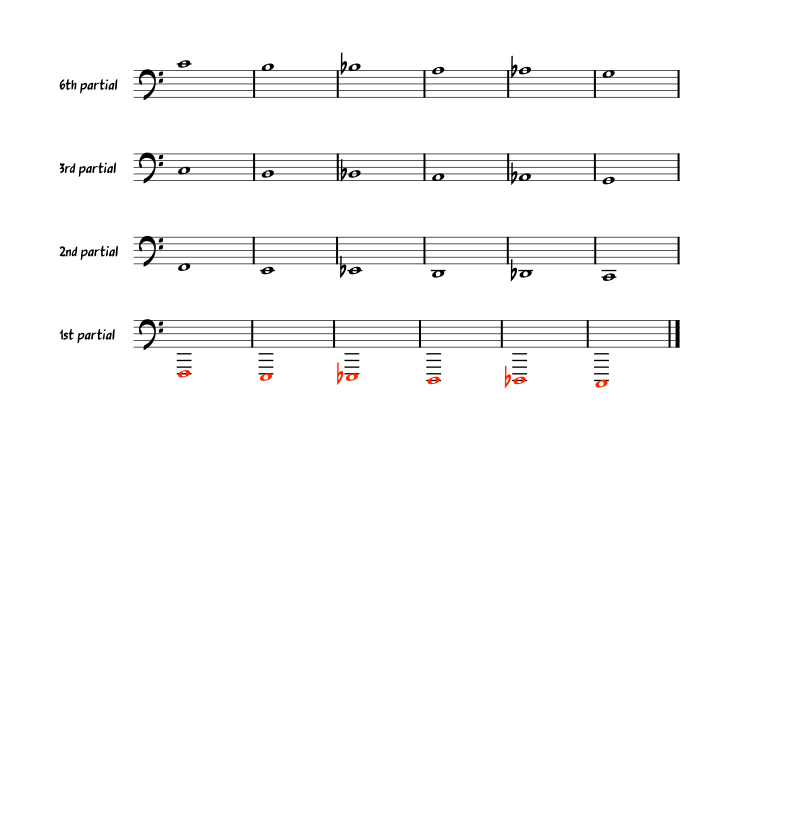
When using the f-attachment there are only 6 positions available.
Some notes are technically on the right partial but are simply hard to hit cleanly as a starting pitch — certain positions on the higher partials are notoriously unreliable for a clean attack, even for experienced players. The 7th partial in 1st position (A♭) is a special case: the note is very flat in pitch on this partial, so players and composers need to be aware of the intonation. The tool flags these situations rather than silently marking them green.
Pedal tones are the 1st partial — a register an octave below the normal low range. They require a very relaxed embouchure and a specific low-pressure air stream that most players develop only with experience. Glissandos using pedal tones are found in professional orchestral and jazz writing but should be used with care in other contexts.
Trombones fitted with an F-attachment (a rotary or axial valve that adds a length of tubing in F) gain access to additional partials that bridge gaps in the low register. Some glissandos are only available via these F-valve partials. This result means the gliss works, but only on an instrument with an F-attachment — not on a basic straight tenor trombone.
Who has an F-attachment? In an orchestral setting you can safely assume all trombone players have one — it is standard equipment in classical playing. In a jazz big band the picture is more varied: the 1st and 2nd chair tenor trombonists often play straight horns without a valve, the 3rd chair typically has an F-attachment, and the bass trombone seat uses a two-valve instrument. If you are writing a glissando that requires the F-valve for a big band tenor part, check which chair it is for.
Most modern bass trombones have two valves. The first is in F, the same as the F-attachment found on many tenor trombones. The second valve is typically tuned to G♭ or G (though other tunings exist), and with an independent valve system — where each valve can be engaged separately or together — it opens up a range of additional harmonic series not available on the open horn or with the F-valve alone.
This means bass trombone players have access to glissandos that are simply out of reach on tenor trombone, particularly in the low register. However, because players and orchestras use different second-valve tunings, a glissando that works in G♭ may not be available in G and vice versa. Unless you are writing for a specific player and know their setup, it is safest to treat the two systems separately and write only to the options available with either tuning — or to consult the player directly.
For more on the different configurations available, see what are the different types of trombones.
If you are new to writing for trombone, how to play the trombone gives useful background on the instrument's mechanics and range.


