

When optimizing your trombone performance, few equipment choices make a more significant impact than your mouthpiece. This small piece of metal is the critical interface between you and your instrument, influencing everything from tone quality and range to endurance and flexibility. A mouthpiece that perfectly matches your physical characteristics, playing style, and musical goals can feel like a revelation, while an ill-suited one can make even the finest trombone feel awkward and unresponsive.
"The mouthpiece is arguably 50% of your sound," says renowned trombone pedagogue Douglas Yeo. "You can have the most expensive professional trombone, but paired with the wrong mouthpiece, it simply won't perform to its potential."
I totally agree!
In this comprehensive guide, we'll explore everything you need to know about trombone mouthpieces in 2025. Whether you're a beginner looking for your first upgrade, an intermediate player seeking to address specific playing challenges, or a professional wanting to fine-tune your setup, this article will help you navigate the sometimes confusing world of mouthpiece selection.
We'll break down the anatomy of mouthpieces, examine how each component affects your playing, look at popular sizes and brands, and provide practical advice for testing and adapting to a new mouthpiece. By the end, you'll know how to make an informed decision that can dramatically improve your trombone experience.
Understanding Trombone Mouthpiece Anatomy
To make the best choice, it's essential to understand the individual components of a trombone mouthpiece and how each affects your playing.
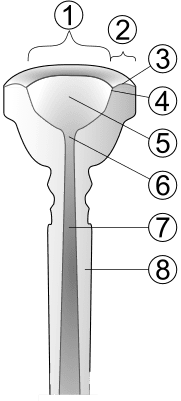
- Inner rim diameter
- Rim width
- Rim contour
- Rim Edge
- Cup
- Throat
- Backbore
- Shank
Let's examine these elements one by one:
Rim Design and Player Comfort
The rim is where your lips make direct contact with the mouthpiece, making it perhaps the most critical component for player comfort.
Rim diameter (also called inner rim diameter or cup width) is typically the first measurement considered when choosing a mouthpiece. Measured in either thousandths of an inch or millimeters, this dimension significantly impacts your playing in several ways:
- Smaller rim diameters (like Bach 12C or 11C): Make high notes easier, can increase endurance, but limit volume and make low notes more challenging
- Larger rim diameters (like Bach 6½AL or 5G): Provide greater volume and easier low notes, but may reduce endurance and make high register playing more demanding
Rim contour and width also significantly affect comfort and playing characteristics:
- Thick, wide rims with flat surfaces: Provide greater lip contact and cushioning for better endurance but limit flexibility
- Thin, narrow rims with rounded tops: Offer more control and flexibility but may cause faster fatigue
Rim bite refers to how sharp or rounded the inside edge of the rim is as it transitions into the cup:
- Sharp bite: Produces more accurate, stable pitch and rich tone but can limit flexibility and reduce comfort
- Rounded, soft bite: More comfortable but may produce less defined articulation and pitch
According to the Yamaha resource guide, "Finding a rim that has the right mix of comfort and performance may require some trial and error. Beginning players are probably better off choosing a rim of medium thickness, but a more experienced player should feel free to experiment with different rim shapes."
Cup Depth and Its Effect on Sound
The cup is the concave area inside the rim where your sound production begins to take shape. Cup depth has a profound impact on tone color and register facility:
- Shallow cups: Support high register playing and produce brighter tones but restrict volume and make low notes more difficult
- Medium cups: Provide balanced performance across registers and are suitable for most players
- Deep cups: Generate darker, fuller tones and make low notes easier but require more effort for high register playing
The overall cup shape (sometimes called cup silhouette) also influences tone:
- "U"-shaped cups: Produce brighter sounds and support high register playing
- "V"-shaped cups: Generate darker sounds and facilitate low register playing
Some specialty mouthpieces, particularly for jazz or lead playing, feature very shallow cups designed specifically for high register work and cut-through brightness. Others, especially those for bass trombone, have extra-deep cups for powerful low notes.
Throat Size and Resistance
The throat (sometimes called the bore) is the small opening at the bottom of the cup. As the narrowest part of the mouthpiece, it creates resistance and focuses the air column:
- Narrow throats: Create more resistance, which contributes to faster response, brilliant tone, and enhanced high register playability
- Wide throats: Make low notes easier and allow greater volume but require more air and may lead to quicker fatigue
Standard Bach small shank trombone mouthpieces typically use a #27 or #28 drill size (0.144" or 0.140") for the throat, while large shank tenor trombone mouthpieces often use larger throats (.261" to .276"). Bass trombone mouthpieces use even larger throats, with some models featuring throats up to .319" to facilitate the extreme low register.
Some bass trombone mouthpieces (like the Bach 1G) are designated with "GM," indicating an extra-large throat designed specifically for bass trombone playing. The "Mega" designations in many product lines also indicate enhanced throat dimensions.
Backbore Shape and Projection
The backbore extends from the throat to the end of the mouthpiece, gradually widening to match the instrument's leadpipe. Its shape and size affect both tone production and resistance:
- Narrow backbores: Help with high notes, create brighter tones, and increase resistance
- Wide backbores: Enhance low notes, produce darker tones, and decrease resistance
Some manufacturers offer specialized backbores for different playing situations. For example, Yamaha notes that their models designed for upper register playing "are built with a tighter backbore to help you reach those high notes."
Shank Size: Small vs. Large
- Small shank (also called "tenor shank"): Traditionally used on smaller-bore tenor trombones, with a narrower connection to the leadpipe. Many student and intermediate tenor trombones use small shank mouthpieces.
- Large shank (also called "bass shank"): Used on bass trombones and many professional large-bore tenor trombones. Examples of tenor trombones that use large shank mouthpieces include the Bach 42B, Conn 88H, and similar professional orchestral models.
The shank size must match your instrument's receiver, though adapters are available in some cases. It's not just a matter of fit—the right shank size complements the acoustic design of your specific instrument. Using the wrong shank size, even with an adapter, can compromise your instrument's sound and response characteristics.
Materials, Weight, and Finish
While shape and dimensions are the primary factors, other aspects of mouthpiece construction also influence performance:
Materials:
- Brass: The standard material for most mouthpieces, offering balanced acoustic properties
- Silver, stainless steel, and other hard metals: Provide powerful, brilliant sounds with less energy absorption
- Plastic and other non-metals: Offer warmer tones, comfort benefits, and advantages in extreme temperatures
Weight and mass:
- Standard weight: Balanced performance for most players
- Heavy mouthpieces: Produce more focused, powerful sounds but may reduce flexibility
Finish:
- Silver plating: Most common, durable and reasonably priced
- Gold plating: More expensive but offers a smoother feel on the lips, improving flexibility and comfort for some players
- Raw brass or other finishes: Less common but may benefit players with metal allergies
According to Yamaha's resource guide, while gold plating feels different to many players, "it's a common misconception that gold plating makes a mouthpiece sound darker or gives the player a warmer tone than silver, but the reality is that the very thin layer of gold has such a small impact on sound that for most players it's essentially not an issue."
How Mouthpiece Selection Affects Your Playing
The mouthpiece you choose has profound effects on virtually every aspect of your trombone playing. Understanding these relationships can help you prioritize which characteristics matter most for your specific needs.
Tone Production and Quality
Your mouthpiece significantly shapes your tone before the sound ever enters the trombone itself:
- Cup depth is perhaps the most influential factor for tone color. Deeper cups produce darker, warmer sounds ideal for orchestral playing, while shallower cups create brighter, more projecting tones often preferred in commercial and jazz settings.
- Throat size affects tone density. Larger throats allow more air to pass through, creating fuller but sometimes less focused sounds, while smaller throats produce more concentrated tones.
- Backbore shape influences tone projection. Wider backbores tend to create a more diffuse sound that blends well in ensembles, while narrower ones produce more direct, focused tones that project better as solo voices.
Range and Flexibility
Different playing requirements call for specific mouthpiece characteristics:
- High register players (lead jazz, commercial music) often prefer mouthpieces with smaller rim diameters, shallower cups, and sometimes tighter backbores to facilitate upper range playing.
- Low register specialists (bass trombone, orchestral tenor) typically benefit from larger rim diameters, deeper cups, and more open backbores to support rich, resonant low notes.
- Flexibility across registers is usually best achieved with medium dimensions that don't extreme in any direction.
If you're struggling with high notes, you might want to check out the article on how to play high notes on trombone, which includes additional advice beyond mouthpiece selection.
Endurance and Comfort
For players who perform for extended periods, comfort and endurance become crucial considerations:
- Rim contour significantly impacts comfort. Rounded rims generally feel better on the lips for long sessions but may offer less stability.
- Rim width affects pressure distribution. Wider rims spread pressure over a larger area, potentially reducing fatigue but sacrificing some precision.
- Gold plating provides a smoother surface that some players find reduces irritation during long playing sessions.
Popular Trombone Mouthpiece Sizes and Their Characteristics
The variety of available mouthpiece sizes can be overwhelming. Here's a breakdown of common sizes and their typical uses, focusing primarily on the popular Bach numbering system as a reference point:
Small Mouthpieces (Bach 12C, 11C, 7C)
These smaller mouthpieces are characterized by:
- Rim diameters around 24.5-24.75mm
- Medium to medium-shallow cups
- Good for beginning students, players with smaller facial features, and some commercial music applications
- Facilitate high register playing and quick response
- The Bach 12C is one of the most common student mouthpieces


Zuletzt aktualisiert am 2026-04-23 / Affiliate-Links / Bilder von der Amazon Product Advertising API
Medium Mouthpieces (Bach 6½AL, 5G)
The workhorse mouthpieces for many trombonists:
- Rim diameters around 25.0-25.4mm
- Medium cup depths
- Versatile for both classical and jazz playing
- Good balance of high and low register capabilities
- The Bach 6½AL is one of the most popular all-around trombone mouthpieces


Zuletzt aktualisiert am 2026-04-23 / Affiliate-Links / Bilder von der Amazon Product Advertising API
Large Mouthpieces (Bach 4G, 3G, 1½G)
These larger mouthpieces offer:
- Rim diameters from 25.5mm to 27.5mm
- Medium-deep to deep cups
- Favored by orchestral players, bass trombonists, and those seeking fuller, darker tones
- Enhanced low register performance and volume
- Require more air support and embouchure strength


Zuletzt aktualisiert am 2026-04-23 / Affiliate-Links / Bilder von der Amazon Product Advertising API
Bass Trombone Mouthpieces (Bach 1½G, 1¼G, 1G)
Bass trombone mouthpieces are specifically designed to facilitate the lower register and produce the powerful sound needed for this instrument:
- Extra-large rim diameters (typically 27.0mm to 29.0mm)
- Deep cups for full, rich low notes
- Larger throat sizes (.276" to .319") to allow sufficient air flow
- Specialized backbores (like Bach's 800S) designed for bass trombone acoustics
- Popular models include Bach 1½G, 1¼G, and 1G
- Many feature dual-bore designs to aid with the extreme low register
- Always use large shank designs to match bass trombone receivers


Zuletzt aktualisiert am 2026-04-23 / Affiliate-Links / Bilder von der Amazon Product Advertising API
Bass trombone players often use mouthpieces with "G" in their designation (in the Bach system), which indicates designs optimized for lower brass instruments. Some players also use "GM" models that feature even larger throats for additional volume and low-register capability.
Specialized Jazz and Commercial Mouthpieces
Many manufacturers offer specialized mouthpieces for specific playing styles:
- Mundstücke für Lead-Jazz weisen oft sehr flache Becher mit kleineren Randurchmessern auf
- Einige verfügen über "Doppelbecher"-Designs, die Helligkeit bieten und gleichzeitig eine gewisse Fülle bewahren sollen
- Oft mit Begriffen wie "Studio", "Lead" oder "Kommerziell" in ihren Beschreibungen gekennzeichnet
Selecting the Right Mouthpiece Based on Your Playing Style
Verschiedene musikalische Kontexte erfordern unterschiedliche Ausrüstungsentscheidungen. So können Sie die Mundstückwahl basierend auf Ihrem primären Spielstil überlegen:
Classical and Orchestral Players
Wenn Sie hauptsächlich klassisches Repertoire oder in orchestralen Einstellungen spielen:
- Erwägen Sie mittlere bis große Randurchmesser (Bach 5G, 4G, 3G oder gleichwertig)
- Suchen Sie nach mitteltiefen bis tiefen Bechern für einen warmen, vollen Ton, der sich gut mischt
- Breitere Rückbohrungen ergänzen den orchestralen Klang optimal
- Mittlere bis mittlere große Kehlen bieten guten Widerstand und erlauben gleichzeitig einen vollen Ton
Wie im umfassenden Trombone Buyers Guideerwähnt: "Orchestralspieler bevorzugen oft reiche, dunkle Töne, die sich gut mit dem Ensemble mischen. Ihre Mundstückwahl sollte diese Ziele ergänzen."
Jazz and Commercial Musicians
Für Jazz-, Kommerz- und Big-Band-Einstellungen:
- Kleinere Randurchmesser funktionieren oft gut (Bach 12C, 11C, 7C oder gleichwertig)
- Flachere Becher helfen bei Projektion und Oberlage-Spiel
- Engere Rückbohrungen können den nötigen Fokus bieten, um sich in einer Band durchzusetzen
- Kleine bis mittlere Kehlen bieten den Widerstand, der beim Ausdauer in anspruchsvollem kommerziellem Spiel hilft
Beginners and Students
Anfänger sollten sich konzentrieren auf:
- Mittlere Mundstücke, die in keiner Dimension zu Extremen neigen
- Komfortable Ränder, die keine unnötige Ermüdung verursachen
- Standardkehlengrößen, die angemessenen Widerstand bieten
- Bach 12C, 11C oder 6½AL sind aus gutem Grund häufige Anfängermundstücke
The Leitfaden für Anfänger-Posaunisten betont, dass "obwohl es verlockend sein könnte, sich für ein spezialisiertes Mundstück zu entscheiden, Anfänger mit Standard-, Mittelweg-Ausrüstung beginnen sollten, die eine ordnungsgemäße Technikentwicklung ermöglicht."
Top Trombone Mouthpiece Brands and Models
Mehrere Hersteller haben sich als Marktführer im Bereich Posaunenmundstücke etabliert. Hier ist ein Überblick über die Top-Marken und ihre bemerkenswertesten Angebote:
Bach Mouthpieces
Vincent Bach-Mundstücke bleiben der Industriestandard, an dem andere oft gemessen werden:
- Konsistente Qualität und weit verbreitet
- Klares Nummerierungssystem (obwohl etwas kontraintuitiv – kleinere Nummern bedeuten im Allgemeinen größere Mundstücke)
- Beliebte Modelle sind der 6½AL (Universalzweck), 5G (Orchester) und 12C (Schüler/Kommerziell)
- "C"-Bezeichnungen deuten auf leicht flachere Becher als Standard an
- "A"-Bezeichnungen deuten auf größere Kehlen an
Denis Wick Mouthpieces
Der britische Hersteller bietet ausgezeichnete Optionen, die besonders bei Orchestralspielern beliebt sind:
- Bekannt für reichhaltige Tonproduktion und konsistente Herstellung
- Klares Nummerierungssystem von 00 (größte) bis 12 (kleinste)
- Beliebte Modelle sind der 4AL, 5AL und 6BS
- Die "Heritage"-Linie bietet Vintage-inspirierte Designs mit moderner Herstellung
Schilke Mouthpieces
Präzisionsgefertigte Mundstücke mit innovativen Designfunktionen:
- Bekannt für Konsistenz und Qualität
- Optionen für jeden Spielstil
- Detaillierte Modellbezeichnungen, die Abmessungen präzise angeben
- Beliebte Modelle sind die 51, 51D und 58
Other Notable Brands and Custom Options
Der Markt hat sich mit Boutique- und benutzerdefinierten Mundstückherstellern erheblich erweitert:
- Yamaha: Bekannt für konsistente Qualität und innovative Designs; ihre Palette umfasst die Standard Series und die Signature Series, die mit Eingaben von Profis entworfen wurde
- Wedge Mouthpieces: Feature ergonomische Randdesigns für Komfort und Ausdauer
- Monette: Präzisionsgefertigt mit einzigartigen Designphilosophien
- Warburton: Modulares System ermöglicht das Mischen und Anpassen von Oberteilen und Rückbohrungen
- Giddings & Webster: Benutzerdefinierte Optionen mit detaillierter Personalisierung
Denken Sie daran, dass prestigeträchtige Markennamen nicht unbedingt eine gute Eignung für Ihre individuellen Bedürfnisse garantieren. Wie der Wikipedia-Artikel über Blechbläser-Mundstücke anmerkt, "persönliche Anatomie und Spielstil bestimmen oft die angemessene Mundstückwahl mehr als der Markenwert."
Tips for Testing and Adapting to a New Mouthpiece
Das Finden Ihres idealen Mundstücks erfordert einen methodischen Ansatz. So testen Sie effektiv und passen sich an ein neues Mundstück an:
What to Listen For During Testing
Bewerten Sie beim Ausprobieren von Mundstücken:
- Tonqualität über alle Register
- Ansprache in Artikulation und Noteneinsätzen
- Flexibilität für Bindungen und Registerwechsel
- Dynamischer Bereich von pianissimo bis fortissimo
- Ausdauer über eine Testsitzung
Aus dem Yamaha-Leitfaden: "Spielen Sie eine Vielzahl verschiedener Musik und Passagen. Versuchen Sie gerne, ein paar hohe Töne zu treffen, aber spielen Sie auch einige langsame, leise Passagen – sowie etwas mit vielen beweglichen Noten und schnellen Artikulationen."
Testing Methodology
Befolgen Sie diese Schritte für effektives Mundstücktesten:
- Beginnen Sie mit Ihrem aktuellen Mundstück als Baseline
- Probieren Sie Mundstücke einzeln aus: Machen Sie sich Notizen zu jedem
- Verwenden Sie Ihr eigenes Instrument für konsistente Vergleiche
- Spielen Sie musikalische Passagen mit denen Sie vertraut sind, nicht nur Tonleitern
- Vergleichen Sie ähnliche Mundstücke hintereinander anstatt wild unterschiedliche Modelle hintereinander zu testen
- Machen Sie Pausen um Ihr Ansatzrohr auszuruhen und einen frischen Blick zu bewahren
Adjustment Period Expectations
Seien Sie auf eine Anpassungsphase mit einem neuen Mundstück vorbereitet:
- Geben Sie sich 2-3 Wochen für eine ordnungsgemäße Anpassung
- Erwarten Sie anfängliche Unbeholfenheit oder Inkonsistenz
- Konzentrieren Sie sich auf die Beibehaltung guter Grundlagen statt unmittelbarer Ergebnisse
- Seien Sie geduldig – die Vorteile entstehen oft allmählich, wenn Sie sich anpassen
Working With a Teacher or Professional
Beziehen Sie nach Möglichkeit einen Fachmann in Ihren Auswahlprozess ein:
- Private Lehrer können Probleme beobachten, die Sie möglicherweise nicht spüren oder hören
- Sie können bestimmte Mundstücke basierend auf Ihrem Spielstil und Ihren Herausforderungen empfehlen
- Sie können helfen zu bestimmen, ob Probleme auf das Mundstück oder die Technik zurückzuführen sind
Wie der Yamaha-Leitfaden betont: "Wenn Sie einen Privatlehrer haben oder mit einem Coach arbeiten, hören Sie auf das, was er vorschlägt. Wenn dieser Ihnen bei dem eigentlichen Mundstück-Ausprobierungsprozess zur Verfügung steht, ist das noch besser!"
Fazit
Die Auswahl des richtigen Posaunenmundstücks ist eine persönliche Reise, die Ihre musikalische Erfahrung erheblich verbessern kann. Obwohl es kein universell "perfektes" Mundstück gibt, gibt es fast sicher eine ideale Übereinstimmung für Ihre spezifische Physiologie, Ihren Spielstil und Ihre musikalischen Ziele.
Behalte diese wichtigen Punkte im Hinterkopf:
- Konzentrieren Sie sich auf das Finden eines Mundstücks, das Ihre wichtigsten Spielprioritäten erfüllt
- Berücksichtigen Sie alle Aspekte des Mundstückdesigns, nicht nur die Randgröße
- Testen Sie systematisch, indem Sie vertrautes Musikmaterial auf Ihrem eigenen Instrument verwenden
- Seien Sie geduldig während der Anpassungsphase mit neuer Ausrüstung
- Wenn Sie unsicher sind, priorisieren Sie Komfort und Spielbarkeit vor technischen Spezifikationen
Das richtige Mundstück sollte sich wie eine Verlängerung von Ihnen selbst anfühlen, sodass Sie sich auf Musik konzentrieren können, anstatt auf Ausrüstung. Durch das Verständnis der in diesem Leitfaden besprochenen Komponenten und die Annäherung an die Auswahl mit Geduld und Bewusstsein werden Sie auf dem besten Weg sein, Ihre perfekte Übereinstimmung zu finden.
Egal ob Sie ein Anfänger sind, der gerade Ihre Posauneneise beginnt, oder ein erfahrener Profi, der Ihr Setup optimiert, investieren Sie die Zeit, um das Mundstück zu finden, das Ihr bestes Spiel hervorbringt. Ihre Lippen, Ihr Publikum und Ihre musikalische Zufriedenheit werden es Ihnen danken.
Haben Sie ein Posaunenmundstück gefunden, das Ihr Spiel verändert hat? Welche Merkmale haben den größten Unterschied für Sie gemacht? Teilen Sie Ihre Erfahrungen in den Kommentaren unten mit!


A seasoned musician who for years has been playing a Yamaha straight tenor trombone (.508 bore) with a Dennis Wick 6BS mouthpiece, I just switched to a Yamaha 51D mouthpiece (equivalent to Bach 5G) for a fuller and darker tone. I feel comfortable playing it. The higher register is more difficult, but with time I believe it will become easier. Is the switch a heresy?
Not a heresy at all — more of a bold upgrade. Moving to a larger cup like the 6BS → 51D/5G is a common choice for players chasing that warmer, darker sound, especially in orchestral or low brass ensemble settings. You're right that the upper register will feel harder at first; the larger cup volume means your embouchure has more air to move. Give it 4–6 weeks of consistent playing and most musicians find their chops adapt. The fact that you already feel comfortable is a great sign. Enjoy the richer tone!